



U.S. Figure Skating Partners Up To Glide Into a New Era of IT
With the help of CDW, the organization looks to unify its data environment and build a foundation for innovation.
At its best, figure skating appears to be effortless.
Athletes leap above the ice, lift their partners high in the air, and land jumps and spins with high precision. But what audiences see in competition is the product of years of training and careful preparation outside the spotlight.
Similarly, the IT systems that support U.S. Figure Skating require a robust foundation of data, networking and applications that help connect members, clubs, athletes, coaches, officials, fans and sponsors across every level of the sport. As part of a new partnership, CDW is set to first assess and then modernize the organization’s technology environment.
“Our goal as a partner is to deliver solutions that help them operate smarter, connect with their community and build a foundation for innovation,” says CDW Enterprise Strategist Jarrod Clark. “That translates into helping U.S. Figure Skating provide an experience that empowers members to grow, achieve, and stay connected to that community and opportunities over a lifetime.”


Why Data Plays a Major Role in Sports
For CDW Enterprise Architect Patton Fast, the connection to U.S. Figure Skating is personal. His wife and his wife’s aunt were both figure skaters, and his 16-year-old daughter now competes in synchronized skating for U.S. Figure Skating at the novice and junior levels.
Fast has seen firsthand how important data and technology have become in a sport that has been part of the Olympic Winter Games since the beginning.
“My daughter’s coaches actually have a coaching app on their phones,” he says. “They will record her doing an axel, and once she’s done, they can take that recording, and the app does an analysis and tells the coach how fast she spun, how high she jumped, how fast she went into the move. Ultimately, the app comes back and says, ‘Your probability of landing that axel appropriately is X. Here’s how you can improve that probability.’ None of that existed years ago.”
Data and technology have also changed the operations of nonprofit athletics associations, including U.S. Figure Skating. Off the ice, the organization is collecting (and connecting) information from not only athletes but coaches, officials, local skating clubs, event organizers, donors, ticket purchasers and corporate sponsors. These data stores open up new opportunities to find officials for regional and local events, to analyze and improve scoring and to illustrate fan engagement levels for potential sponsors.
However, much of this data is currently siloed, making it difficult for U.S. Figure Skating to unlock its full potential.
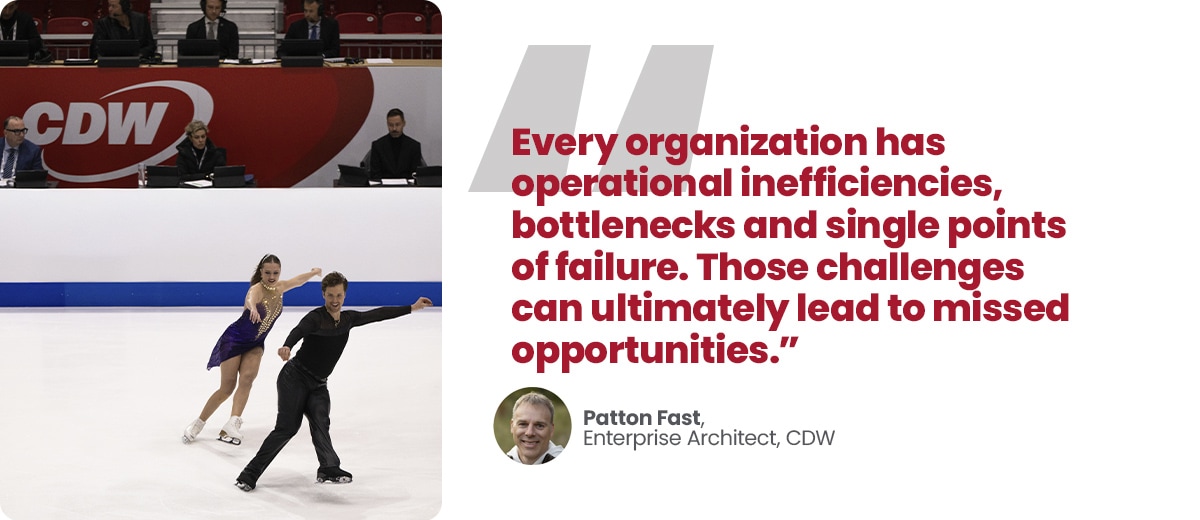
“It’s not a big enterprise organization,” Fast says. “It’s a relatively small nonprofit that just happens to have a high profile. But a lot of what it does is the same as everyone else. Every organization has operational inefficiencies, bottlenecks and single points of failure. Those challenges can ultimately lead to missed opportunities.”
“The organization has a ton of data, but it’s not all connected,” Clark adds. “When that happens, you don’t always even know what you’re missing out on with insights and analytics.”


Modernization Requires Teamwork
Although the partnership between U.S. Figure Skating and CDW is just getting started, Tim Flynn, chief architect for CDW Advisory Services, says that early conversations with U.S. Figure Skating executives have been overwhelmingly positive.
“This partnership is really interesting for me, to see the back-end operations and get a better understanding of how hard it is for these athletes, what they’re doing and how they’re leveraging technology to get better on a day-to-day basis,” Flynn says. “When I was growing up, I think most households became skating fans every four years, because that’s one of the sports that’s prominent on TV and it has a lot of high-profile Olympic athletes. So, this partnership is a great opportunity to see behind the scenes and correlate that to what we see every four years on TV.”
Fast says that CDW’s work will likely begin with an in-depth assessment of U.S. Figure Skating’s critical applications and data environment.
“Like many organizations, their applications include a lot of homegrown code that they’ve developed over the years,” he says. “We’re evaluating the applications and then also doing an analysis of where the data is, how it is connected, how it is stored, and then the security around both the applications and the data.”
CDW has already met with key U.S. Figure Skating personnel to better understand current challenges and future goals. “They’re looking to us to focus on building a strong foundation and close the integration gap between their existing systems,” Clark says. “One of the first things we’ll be looking at is how they can connect their data and then use those new connections to drive additional engagement or revenue, using what they already have.”
Going for the Gold
For many organizations, breaking down data silos can be a catalyst for better decision-making, operational efficiency and strategic insights. In the realm of athletic competition, it could mean improving officials’ allocation at local competitions, maintaining more consistent scoring or tracking athlete development.
One of the challenges U.S. Figure Skating faces, for example, is that it can struggle at times to get officials for the smaller, local competitions that happen year-round. “If they can integrate data from across all of their events and IT systems, they might be able to get better utilization of officials,” Fast says.
More integrated data could also transform how athletes develop over time, Flynn says.
“In all sports, data has become an integral part of training and advancement, helping athletes take their skill sets to the next level,” he adds. “From a health perspective, we’re seeing it in things such as heart rate tracking, and there are all sorts of nuances in how your body recovers. Technology is critical. It goes hand in hand with athletics now, and how coaches and teams are using data to improve athletes’ overall performance.” CDW and U.S. Figure Skating will pursue the most promising opportunities that arise during their work together, whatever those might be.
“We’re seeking to put together a program that helps them leapfrog into the next era of U.S. Figure Skating,” Flynn says.
Clark echoes this idea, adding that the partnership is aimed at creating benefits that extend across the entire U.S. figure skating ecosystem, from local club volunteers to aspiring Olympians.
“Hopefully, our work will help improve the experience of athletes, coaches and fans,” Clark says. “Potentially, this partnership could contribute to winning a gold medal one day. That’s super exciting.”



Calvin Hennick
Freelance Journalist
