

HPE Aruba RAP-3WNP - wireless access point
Mfg # RAP-3WNP-US-CS
CDW # 3205560
| UNSPSC 43222640

Know your gear
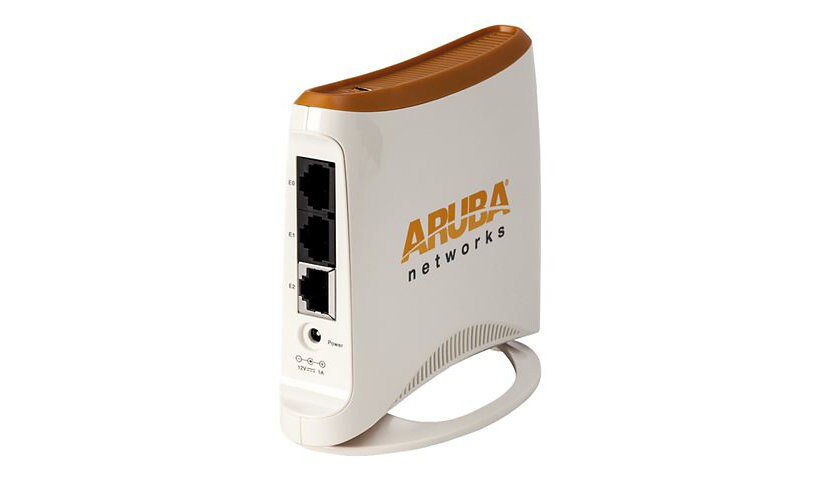
The multifunctional Aruba RAP-3 delivers secure 802.11n wireless and wired network access to corporate resources from branch and home offices. Centrally managed by Aruba Mobility Controllers, the RAP-3 extends corporate resources to remote locations by establishing site-to-site VPN tunnels to the data center.
The RAP-3 offers a variety of enterprise-class features, including role-based network access, policy-based forwarding, and Adaptive Radio Management (ARM), which gives remote workers the same high-quality Wi-Fi experience they get at corporate headquarters.
Delivering a wireless data rate of up to 300 Mbps, the RAP-3 has three 10/100BASE-T Ethernet ports and one USB port for connecting to 3G and 4G networks. It is also available with an 802.3af power-over-Ethernet (PoE) port for IP phones or other devices.
At locations that require greater coverage, the RAP-3 can join an Aruba Instant WLAN cluster. Simply install additional RAP-3s or any Instant AP and the entire cluster is managed as one. If one Instant AP fails, another AP automatically takes over with no disruption.
For large installations, the Aruba Product Activation Service dramatically reduces deployment time by automating device provisioning, firmware upgrades and inventory management. RAP-3s are factory-shipped to your remote offices and configure themselves when powered up.
The RAP-3 offers a variety of enterprise-class features, including role-based network access, policy-based forwarding, and Adaptive Radio Management (ARM), which gives remote workers the same high-quality Wi-Fi experience they get at corporate headquarters.
Delivering a wireless data rate of up to 300 Mbps, the RAP-3 has three 10/100BASE-T Ethernet ports and one USB port for connecting to 3G and 4G networks. It is also available with an 802.3af power-over-Ethernet (PoE) port for IP phones or other devices.
At locations that require greater coverage, the RAP-3 can join an Aruba Instant WLAN cluster. Simply install additional RAP-3s or any Instant AP and the entire cluster is managed as one. If one Instant AP fails, another AP automatically takes over with no disruption.
For large installations, the Aruba Product Activation Service dramatically reduces deployment time by automating device provisioning, firmware upgrades and inventory management. RAP-3s are factory-shipped to your remote offices and configure themselves when powered up.
Enhance your purchase
HPE Aruba RAP-3WNP - wireless access point is rated
4.30 out of
5 by
16.
Rated 5 out of
5 by
reviewer2646858 from
Regular updates ensure smooth operation with extensive reach in large environments
What is our primary use case?
We have an access point in pretty much every room, servicing about twelve thousand people. We are utilizing just switches and access points, as well as ClearPass and Mobility Master.
What is most valuable?
Aruba Remote Access Points have not required a lot of adjustment. Once we got things set up properly, we just need to do updates, and it just runs. Their ability to perform without frequent adjustments or interruptions has been valuable.
What needs improvement?
Unfortunately, I don't really have any critiques at this time.
For how long have I used the solution?
We have been using Aruba Remote Access Points in the district for about three or four years.
What do I think about the stability of the solution?
We haven't had too many outages. Occasionally, we run into issues with interference, but for the most part, they have been fairly stable.
What do I think about the scalability of the solution?
We are able to add more access points without issues. The scalability seems fine.
How are customer service and support?
Aruba support has always been able to assist me and answer my questions, so I would probably give them an eight or nine out of ten.
How would you rate customer service and support?
Positive
Which solution did I use previously and why did I switch?
Before this, in my previous company, we used Ruckus. The Ruckus AP seemed a little bit more higher-end, but they were more expensive and had a really neat cloud support, which Aruba also offers, though we aren't paying for it.
How was the initial setup?
The initial setup is very straightforward. I just have to connect the points to our network, and Mobility Master will pick it up and can run the configuration and updates from there.
What other advice do I have?
The stability and performance of Aruba Remote Access Points with minimal issues in an IT environment are worth a recommendation.
Overall, I would rate the Remote Access Points as an eight out of ten.
Which deployment model are you using for this solution?
On-premises
Disclaimer: I am a real user, and this review is based on my own experience and opinions.
Date published: 2025-02-12T00:00:00-05:00
Rated 5 out of
5 by
Virendra Kumar from
Remote management of cloud-connected devices with efficient configuration deployment for multiple locations
What is our primary use case?
We received the project from Government of Bihar for campus Wi-Fi. We used Aruba Remote Access Points, Aruba devices, and Aruba switches as part of the solution. We utilized Aruba Cloud, specifically Instant On Cloud, which is a public cloud hosted by Aruba. All access points and switches were connected to that cloud, allowing us to manage and configure them remotely.
What is most valuable?
I appreciate the configuration deployment features. If I want to configure many devices at various locations simultaneously, this feature is exceptional. I can execute it as a single point of contact, just clicking to import the config file, and all devices get configured. The security features are also satisfactory since it is not just a public cloud but an Aruba-hosted public cloud. I need to create credentials, making it more secure as devices connect to the organization. Each device is added with its serial numbers and activation codes.
What needs improvement?
They can add more graphical reporting systems so that network admins and system admins get more information about user usage, such as which user, what they use, and when they use it.
For how long have I used the solution?
I used the product until seven to eight months ago.
What do I think about the stability of the solution?
The stability is very good. I would rate it nine out of ten.
What do I think about the scalability of the solution?
It is scalable, but I would rate it eight out of ten. While it is fine for our projects, there is room for improvement.
How are customer service and support?
The technical support is very good.
How would you rate customer service and support?
Positive
How was the initial setup?
The setup process was simple. It was a simple, cloud-based setup.
What's my experience with pricing, setup cost, and licensing?
The pricing is adequate. It is available in every range, from medium range to high range and enterprise level. Thus, it is not an issue.
Which other solutions did I evaluate?
I have used Aruba, Juniper, Mist, and Cisco Meraki. While I have not used Ruckus, I find Juniper Mist more preferable.
What other advice do I have?
Overall, I would rate Aruba Remote Access Points nine out of ten. I can definitely recommend them to other users.
Which deployment model are you using for this solution?
Public Cloud
If public cloud, private cloud, or hybrid cloud, which cloud provider do you use?
Other
Disclaimer: My company has a business relationship with this vendor other than being a customer:Partner
Date published: 2025-04-23T00:00:00-04:00
Rated 5 out of
5 by
Luis Malaga from
Intuitive management and cost-effectiveness benefit industry deployment while deployment distribution can improve
What is our primary use case?
I use Aruba Remote Access Points in an industry setting, specifically within a bank. It is deployed in a large company.
What is most valuable?
The Aruba Remote Access Points are simple, not expensive, and very intuitive for management and configuration. They provide great wireless functionality with one controller and multiple access points. The solution is also reasonably priced and not expensive, making it accessible. Additionally, the intuitive management and configuration enhance its usability.
What needs improvement?
In terms of improvement, the distribution of appliances could be better. While the functionality is good, some aspects of deployment can be complex. Scalability can also be improved from the current rating of seven.
For how long have I used the solution?
I have experience for three years using Aruba solutions.
What was my experience with deployment of the solution?
The deployment is not difficult; it is very easy.
What do I think about the stability of the solution?
I would rate stability as five out of ten. Sometimes it is stable, and sometimes it is not.
What do I think about the scalability of the solution?
Aruba Remote Access Points have scalability issues and I would rate scalability as seven out of ten, meaning it can be enhanced further.
How are customer service and support?
The technical support from Aruba is very fast. When I have any questions, the support pack responds very quickly.
How would you rate customer service and support?
Positive
Which solution did I use previously and why did I switch?
I have experience with FortiAP and found that Aruba does not require additional components like FortiAP does. With FortiAP, I needed a Forti controller, but Aruba just requires the equipment itself.
How was the initial setup?
The setup of Aruba Remote Access Points is very simple and straightforward.
What's my experience with pricing, setup cost, and licensing?
The pricing is good and not expensive. I find the solution to be reasonably priced.
Which other solutions did I evaluate?
I have experience with other vendors like Fortinet.
What other advice do I have?
I would recommend Aruba Remote Access Points to others because they are simple, not expensive, and intuitive for management and configuration. Overall, I would rate the solution as seven out of ten.
Disclaimer: I am a real user, and this review is based on my own experience and opinions.
Date published: 2025-03-04T00:00:00-05:00
Rated 5 out of
5 by
Bjorn Bell from
Cloud management simplifies network operations with valuable insights
What is our primary use case?
We use Aruba Remote Access Points on a daily basis for easy management. They are a vital part of our IT infrastructure, providing reliable connectivity and solutions for everyday networking tasks.
What is most valuable?
The most valuable feature of Aruba Remote Access Points is the manageability from the central cloud platform. The unified platform simplifies daily operations, making it easier not just for me but also for my staff. Additionally, the AI insight on the central platform helps troubleshoot further by providing insights on network usage, such as which frequency band is being used.
What needs improvement?
One thing that would be beneficial is for the Aruba Central mobile app to work more effectively. Currently, it does not function as expected when I really need it.
For how long have I used the solution?
I have been working with Aruba Remote Access Points for just over two years.
What was my experience with deployment of the solution?
Deployment was straightforward. It was a simple plug-and-play process. Setting up on a controller ensures there are no issues, and deploying can be done in under a day, even half a day if it is close to the tower.
What do I think about the stability of the solution?
I don't have any issues with Aruba Remote Access Points. They are very reliable, and any issues usually stem from external factors like fiber issues.
How are customer service and support?
I have spoken with Aruba's technical team and have been very satisfied with the quality of support received.
How would you rate customer service and support?
Neutral
Which solution did I use previously and why did I switch?
Other solutions like Meraki's and Cisco's were tried, but nothing compared to Aruba Remote Access Points being under a unified platform, which eases daily operations.
How was the initial setup?
The initial setup was easy, with a plug-and-play method, making it straightforward to get up and running without issues.
Which other solutions did I evaluate?
A few solutions like Meraki and Cisco were tested, but none provided the ease of use and unified platform benefits that Aruba Remote Access Points offer.
What other advice do I have?
Overall, I rate Aruba Remote Access Points a strong eight out of ten. Despite its reliability and efficiency, perfect ten ratings are rare because improvements can always be made.
Which deployment model are you using for this solution?
Public Cloud
If public cloud, private cloud, or hybrid cloud, which cloud provider do you use?
Other
Disclaimer: I am a real user, and this review is based on my own experience and opinions.
Date published: 2025-03-24T00:00:00-04:00
Rated 5 out of
5 by
AndresEcheverry from
Easy to configure and deploy
What is most valuable?
The tool's most valuable features are its ease of configuration and deployment.
What needs improvement?
The product is not user-friendly.
What do I think about the scalability of the solution?
For scalability, I'd rate it eight or nine out of ten. Adding a few devices is easy.
How are customer service and support?
The support wasn't very good. The support team was from India and couldn't solve our problem. They only gave us a factory reset on about ten devices, and they didn't provide any other options to fix the issue. I would rate their initial support a six out of ten.
How would you rate customer service and support?
Positive
How was the initial setup?
The product's deployment is easy.
What's my experience with pricing, setup cost, and licensing?
Aruba Remote Access Points' pricing is good and affordable.
What other advice do I have?
I use Aruba Remote Access Points in offices but not in crowded spaces with a high density of devices. For those, I recommend Ruckus. I had one disappointing case four years ago, but it was solved with a firmware update and hasn't happened since.
I haven't tried the tool's enterprise line in high-density scenarios, so I still recommend Ruckus for those based on my experience. Overall, I'd rate Aruba Remote Access Points nine out of ten. The reason it's not ten is because they only had one or two Wi-Fi 7 access points available when I was looking for a solution recently.
Disclaimer: My company has a business relationship with this vendor other than being a customer:Partner
Date published: 2024-08-19T00:00:00-04:00
Rated 5 out of
5 by
reviewer2169333 from
Ensures responsive customer support and competitive pricing, but may lack scalability and effectiveness in rapidly evolving networking landscapes
How has it helped my organization?
Our experience with Aruba Remote Access Points for branch office connectivity has been satisfactory, considering they're older models. While they generally work and fulfill their purpose without significant complaints from users, we've encountered challenges in keeping up with firmware updates. As they're not the latest models, we've made a strategic decision to transition away from relying on them heavily. Instead, we're prioritizing planning for long-term coverage solutions, finding them more effective in meeting our needs compared to sporadic deployment of remote access points.
What needs improvement?
Its scalability capabilities should be improved.
For how long have I used the solution?
I've been working with Aruba Remote Access Points for about a year since joining the company. While we used them extensively in the past, lately, we haven't been utilizing them as much. Our focus has shifted towards designing outdoor coverage solutions for scenarios where remote access points aren't necessary.
What do I think about the stability of the solution?
When it comes to stability, I would rate Aruba Remote Access Points a seven or eight out of ten. Once configured and operational, they tend to function reliably, with few reported issues from clients or customers. Additionally, they are often reused, which further speaks to their stability.
What do I think about the scalability of the solution?
In terms of scalability for the Aruba Remote Access Points, our utilization differs from other companies. While many organizations use them for branch offices, our situation is unique. We didn't have to worry about deploying RAPs extensively because we lacked branch offices. The few instances where we did utilize them involved more effort in configuring and setting up custom solutions, which didn't scale well for us. Since we own the locations where employees work, there wasn't a significant need for off-site connectivity. Those instances that did require off-site access were already integrated into our network. I would rate the scalability of Aruba Remote Access Points a five out of ten. While they are useful, there comes a point where manageability starts to diminish. Since they are not directly tied to the network like traditional access points, they pose some unique challenges.
In high-demand scenarios, the performance of Aruba Remote Access Points can vary. While they are built to handle substantial usage, I cannot provide specific numbers. However, we have deployed them successfully for numerous outdoor events and large gatherings where many users connect to them. Despite their capability to handle heavy loads, overutilization is not ideal.
How are customer service and support?
Regarding tech support for Aruba Remote Access Points, we don't often reach out to their representatives as we don't heavily rely on RAPs. From our perspective, some positive aspects of Aruba's support include its responsiveness and commitment to tracking and resolving issues. They consistently engage with us until a resolution is found, ensuring we are not left behind. At times, we find that the resolutions provided are not satisfactory. We sometimes receive answers that seem rushed or don't align with our situation. Consequently, we feel that the solutions offered may not address the actual issue at hand. Based on our interactions, I would rate their customer service as satisfactory, ranging from good to okay. On a scale of one to ten, I would give it a six.
How would you rate customer service and support?
Neutral
How was the initial setup?
About the initial setup of the Aruba Remote Access Points, I didn't actuallyhandle most of the configurations myself. However, based on feedback from my team, they found the setup process to be relatively straightforward and not overly complicated. I would rate it around a six or seven out of ten.
What about the implementation team?
The deployment time for Aruba Remote Access Points is typically short once the site is ready. Since we provide them to the customer for placement, as long as there's an outlet available, deployment is straightforward. Maintenance requires around ten people involved. The upkeep can be tricky due to firmware upgrades, requiring careful attention to ensure compatibility. While maintaining them isn't our primary focus, we recognize the importance of keeping them up-to-date.
What's my experience with pricing, setup cost, and licensing?
In terms of pricing, we've found Aruba's offerings to be very competitive. We haven't encountered any significant issues or complaints with the pricing of their Remote Access Points, as they generally align well with our budget. Regarding specific product lines, pricing can vary depending on the model. Newer models can cost over a thousand dollars, while older ones typically range from around five to seven hundred dollars. However, we've generally found the pricing to be reasonable and haven't felt that we're overpaying for the quality of the products we receive.
What other advice do I have?
In terms of recommending Aruba Remote Access Points, it depends on the specific scenario. Currently, with the evolving landscape of networking technologies, including the shift towards cloud-based solutions, traditional RAPs may not be as relevant. Many vendors are transitioning towards cloud-based support, which offers easier access and management for remote offices or sites. Since cloud connections are becoming more prevalent, it's like having a "virtual RAP" for accessing the internet. Therefore, my recommendation would lean towards cloud solutions for remote connectivity, as they align with the direction vendors are moving towards. This approach ensures compatibility with future advancements in networking technology. Overall, I would rate it five out of ten.
Disclaimer: I am a real user, and this review is based on my own experience and opinions.
Date published: 2024-03-25T00:00:00-04:00
Rated 5 out of
5 by
Theesula Majuwanagamage from
Efficient Setup and Strong Performance Highlight Versatile Capabilities
What is our primary use case?
My relationship with Aruba Remote Access Points is that if the consultant specifies the HP Aruba one, then the customer goes with that specification and recommendation. Based on my experience as a technical expert, both Cisco and Aruba Remote Access Points deliver the same results.
There are a few differentiations, but in my opinion, as a technical professional, only the name and physical size differ. Both are meeting customer expectations, especially under firewall management and broadband management systems, with an emphasis on high-security applications. Normal access control doesn't limit or block any traffic; all these tasks are managed by firewalls. In Sri Lanka, we use access points below 23 dB indoors, while over 23 dB is for telecommunications providers.
When planning implementation, we have to consider surrounding equipment, as wireless means dealing with EMF signals. Knowing the behavior of EMF signals is crucial instead of just having high-end access points; placement and installation are key to maximizing the effectiveness of these devices. Otherwise, increasing the power level might not provide the proper signal and can create interference.
What is most valuable?
There are no bad features in Aruba Remote Access Points. Every feature is customized to meet customer requirements according to their limitations, and we can make use of all features to benefit us as needed.
What needs improvement?
In terms of areas for improvement in Aruba Remote Access Points, when planning for the customer's end, you need to highlight the precautions against EMF emissions and environmental emissions, as well as power management limitations.
If the user is in one direction and you're transmitting everywhere, that's not good power management. Currently, all access points provide the same power requirement to the client, but we should explore what extra mile we can go. We are facing energy crises and climate issues, along with GHG and SDGs protocols. If we highlight the alignment with these protocols, it can enhance the product quality as an environmentally friendly option.
Apart from that, service-wise, every unit is the same. Users can only distinguish those requirements using spectrum analyzers; otherwise, minor data delays of one or two seconds do not matter, but for high-security or high-speed needs, it becomes significant.
For how long have I used the solution?
I have worked with Aruba Remote Access Points for around two to three years.
What do I think about the stability of the solution?
The Aruba Remote Access Points are a stable solution. Every system is stable within its operational limits. If installed beyond its range or under unsuitable conditions, it will not maintain stability.
What do I think about the scalability of the solution?
Aruba Remote Access Points are a scalable solution.
How are customer service and support?
Technical support from Aruba Remote Access Points is good; they are doing excellent work. If I were to rate them numerically, I would give them around eight, though I cannot provide an exact figure. If marketed, it could be advertised as eight or nine.
How would you rate customer service and support?
Positive
How was the initial setup?
Regarding the initial setup of Aruba Remote Access Points, if the user knows how to manage it, it's simple; if they don't, it will be complex.
What other advice do I have?
I would rate Aruba Remote Access Points overall around eight or nine; it's not the best solution. Each customer's requirement differs, and since this is a passive device while we are using active devices, there will be definite limitations in matching them. My overall rating for this solution is 8 out of 10.
Which deployment model are you using for this solution?
On-premises
If public cloud, private cloud, or hybrid cloud, which cloud provider do you use?
Other
Disclaimer: My company has a business relationship with this vendor other than being a customer.Partner
Date published: 2025-06-25T00:00:00-04:00
Rated 5 out of
5 by
David Justice from
Straightforward setup, beneficial IP protection, and highly reliable
What is our primary use case?
We use Aruba Remote Access Points as a VPN.
What is most valuable?
Aruba Remote Access Points provide a level of protection for our IPs.
For how long have I used the solution?
I used Aruba Remote Access Points within the last 12 months.
What do I think about the stability of the solution?
The stability of Aruba Remote Access Points is great.
What do I think about the scalability of the solution?
I am impressed with the scalability of Aruba Remote Access Points.
How was the initial setup?
The implementation of the solution is straightforward.
What about the implementation team?
We have a team that is implementing the Aruba Remote Access Points.
What's my experience with pricing, setup cost, and licensing?
The price of Aruba Remote Access Points could be better. It is a little expensive.
I rate the price of Aruba Remote Access Points a two out of five.
What other advice do I have?
I rate Aruba Remote Access Points an eight out of ten.
Which deployment model are you using for this solution?
On-premises
Disclaimer: I am a real user, and this review is based on my own experience and opinions.
Date published: 2022-04-07T00:00:00-04:00
Rated 5 out of
5 by
Heraldo Conceicao from
Provide the same network remotely as on-site
What is our primary use case?
I use Aruba Remote Access Point for remote work.
What is most valuable?
The possibility that you have the same network that we have on-site remotely, that's a great feature.
What needs improvement?
There is room for improvement in terms of pricing. If they can be more competitive.
What do I think about the stability of the solution?
It is a very stable tool.
What do I think about the scalability of the solution?
The scalability is good. I think all over the equipment, they scale very well.
How was the initial setup?
The initial setup up was pretty easy.
Which other solutions did I evaluate?
There was a process for buying that equipment in which Sysco was also considered. However, Aruba gained the part mostly due to the features and overall cost of the product.
Disclaimer: I am a real user, and this review is based on my own experience and opinions.
Date published: 2023-03-24T00:00:00-04:00
Rated 5 out of
5 by
Mike Lin from
Offers easy configuration and excellent support
What is our primary use case?
We've deployed them in a couple of warehouses and outdoor events. They work well in large spaces, especially for manufacturing. That's when you start seeing the effectiveness of Aruba compared to products like Ubiquiti, even for home use.
Lately, I've been installing the lower-end Aruba Access Points, such as the Instant On series, which is pretty much plug-and-play out of the box. It's much easier compared to Ubiquiti or other similar products, even Amazon's own offerings.
Hands down, Aruba is far better than consumer-oriented because Aruba brings enterprise-level quality to the consumer market. It's easier, better, and cheaper compared to options like Meraki or Cisco products.
What is most valuable?
The most valuable features are the easy configuration, ease of installation, and excellent support. If you encounter any problems, the support team is incredibly helpful. You don't have to wait for hours or go through unnecessary troubleshooting steps. They are great, especially for first-time installations. Additionally, the ability to integrate with other platforms is a significant advantage.
What needs improvement?
There are some issues, like the VLAN capabilities and support for routing between two VMs. These require Layer 3 switching, which Aruba partially covers but not a hundred percent. It can be frustrating for someone who knows about the product and want to implement specific features that are not fully supported by the current software.
For how long have I used the solution?
I have been using Aruba Remote Access Points for more than ten years.
How are customer service and support?
The customer service and support team is really great.
How would you rate customer service and support?
Positive
How was the initial setup?
The initial setup is very straightforward. Basically, once you install it, you're pretty much done. You may encounter some issues when upgrading the firmware, but other than that, it's pretty straightforward.
What's my experience with pricing, setup cost, and licensing?
Aruba pricing is not very high. They offer competitive pricing for what they provide. As you move up their product line, the pricing becomes better than Cisco's. In terms of pricing, I would give the pricing a six out of ten; it is somewhere in the middle of the range. The access points are quite reasonable. I would say they are about a five.
What other advice do I have?
Overall, I would give them a nine. I can never give anybody a ten. Everyone can improve.
Disclaimer: My company has a business relationship with this vendor other than being a customer:Implementer
Date published: 2023-06-01T00:00:00-04:00
Rated 5 out of
5 by
Aneesh K from
A tool for secure Wi-Fi connection that needs to introduce a cloud version of the product
What is our primary use case?
My company uses Aruba Remote Access Points for those office users who work from home, which can be categorized into VIP users who regularly work from home. In general, my company provides Aruba Remote Access Points for those who work from home. One can have Aruba Remote Access Points connected to their home internet and get connected to our corporate network.
What is most valuable?
The most valuable feature of the solution is experienced by those working at home since they get a secure Wi-Fi connection. The solution also provides a feature known as VoIP, where one can also get connected via phone. With the solution, one can get the corporate network in their home for wired ports, printers, and all the static devices, making it a kind of mini switch. The VIP and executive users of the solution in my company expect the aforementioned features to be included since they expect the features they would have received had they been working from the office.
What needs improvement?
Since Aruba Remote Access Points is an on-premises tool, my company must deploy the VPN gateway everywhere. It would have been helpful to manage multiple gateways on the solution if Aruba Remote Access Points introduced a cloud or SaaS-based version. The solution's AI capabilities need improvement since many manual things are involved presently. Automation in the solution can happen with more AI capabilities.
The solution's technical support has some shortcomings that need improvement.
For how long have I used the solution?
I have been using Aruba Remote Access Points for two years. My company is a customer of Aruba.
What do I think about the stability of the solution?
Aruba Remote Access Points is a stable product because there are no major complaints our company has received from any clients. The software bugs will be there, and Aruba usually fixes bug-related issues in the following version release of the product. Overall, it's a good and stable solution that we have kept in our company for more than five years.
What do I think about the scalability of the solution?
Scalability-wise, there are some problems since it's all a manual process. It is not possible to go for auto-scaling. From a hardware perspective, even if the product is purchased with the proper license, there are no auto-scaling options provided to the user. In our company, we have to scale the solution manually, especially when it comes to the licensing and hardware part where an upgrade is required. Suppose the current gateway supports around 500 clients or access points, and you wish to upgrade, then it is not provided in the solution as part of a scaling option with some simple license update. In our company, we have to upgrade the whole hardware itself.
How are customer service and support?
I rate the technical support a seven out of ten.
How would you rate customer service and support?
Neutral
How was the initial setup?
The initial setup of the product is not complex, but it is not a simplified solution either since we still need to follow the traditional setup phase process in our company. The solution comes up with more manual intervention during the setup phase.
What other advice do I have?
The product is good, but Aruba still follows a more traditional approach at a time when a transformation should happen. A lot of transformation has to happen to complete the product.
I rate the overall solution a seven out of ten.
Disclaimer: I am a real user, and this review is based on my own experience and opinions.
Date published: 2023-09-04T00:00:00-04:00
Rated 5 out of
5 by
Abdelfattah Bencheikh from
Stable product with an advanced filtering feature
What is our primary use case?
We use the product to manage and provide remote access to our branches and HQ.
What is most valuable?
The platform has the most valuable advanced filtering feature.
What needs improvement?
The product needs an increased level of security for the end user.
For how long have I used the solution?
We have been using Aruba Remote Access Points for four years.
What do I think about the stability of the solution?
I rate the platform’s stability a nine out of ten.
What do I think about the scalability of the solution?
I rate the product’s scalability an eight out of ten.
How are customer service and support?
The technical support team is helpful.
How would you rate customer service and support?
Positive
Which solution did I use previously and why did I switch?
We prefer Aruba Remote Access Points for their stability and performance.
How was the initial setup?
The installation process is complex and needs two days to complete. It requires five engineers to work on the maintenance.
What's my experience with pricing, setup cost, and licensing?
There are no other expenses than standard licenses for the product.
What other advice do I have?
I rate Aruba Remote Access Points an eight out of ten. It has a complex process for integration, router configuration, and troubleshooting.
Which deployment model are you using for this solution?
On-premises
Disclaimer: My company has a business relationship with this vendor other than being a customer:
Date published: 2023-11-26T00:00:00-05:00
Rated 5 out of
5 by
Virendra Kumar from
Great authentication features and assists us in deploying security access networks
What is our primary use case?
We have many government colleges here and provide a wireless network to all students, faculty, and teachers. So we have deployed their security access network and firewall security. We use Aruba Remote Access Points for wireless connectivity. Our clients are colleges and universities.
What is most valuable?
The authentication features are valuable.
What needs improvement?
It could have better monitoring features. Not all features are available on the monitoring dashboard.
For how long have I used the solution?
We have been using this solution for one and a half years, and it is deployed on-premises.
What do I think about the stability of the solution?
The stability is good.
What do I think about the scalability of the solution?
It is scalable, with about 1,000 to 1,500 users per campus, and we plan to increase it. We have 319 colleges, and we have about 35 employees.
How are customer service and support?
The technical support is good. I rate them a nine out of ten.
How would you rate customer service and support?
Positive
How was the initial setup?
It is easy to set up.
What's my experience with pricing, setup cost, and licensing?
I do not have details about the pricing because I work on the implementation team.
Which other solutions did I evaluate?
We have not used other solutions.
What other advice do I have?
I rate this solution a nine out of ten. I would recommend this solution to others.
Disclaimer: My company has a business relationship with this vendor other than being a customer:Implementer
Date published: 2022-11-29T00:00:00-05:00
Rated 5 out of
5 by
Ali Fauzi from
Simple to scale, but complicated payment structure
What is our primary use case?
My company uses this solution for endpoint protection.
What is most valuable?
The product is very flexible.
What needs improvement?
Our difficulty with Aruba is that the product and the license are two different items. So, if we are adding an access point, we have to pay for two items. We have to pay to add the access point in the controller and we have to pay for the license.
For how long have I used the solution?
I have been using this solution for about three years.
What do I think about the stability of the solution?
So far the stability of the solution has been good.
What do I think about the scalability of the solution?
We set up Aruba with six access points and we have scaled up to twelve access points. It is quite simple to scale.
Which solution did I use previously and why did I switch?
I used Ruijie before I switched to Aruba. I chose Aruba because it is known for being a good brand and a good choice.
What about the implementation team?
The solution was deployed by a vendor team of three engineers and it took about three weeks. I'm currently configuring it and handling the maintenance myself and the level of difficulty is medium.
What other advice do I have?
I would rate this solution as a seven out of ten.
Which deployment model are you using for this solution?
On-premises
Disclaimer: I am a real user, and this review is based on my own experience and opinions.
Date published: 2022-06-29T00:00:00-04:00
Rated 5 out of
5 by
Mohamed_Rumaiz from
Provide remote access points with one-time deployment and configuration
What is most valuable?
There are numerous remote access points in the health sector, such as the Ministry of Health. The government operates a remote channeling center, collecting data on incoming and outgoing points and then provided to relevant organizations. In my country, these activities are facilitated by Broadband Access, and we are actively engaged in them.
It's a one-time deployment and configuration process. Unless there is a natural disaster, there should be no interruption. There may be a temporary pause in the event of a natural disaster. This solution is widely adopted and involves both technology and non-technical devices. It is robust, except in cases of significant power outages.
For how long have I used the solution?
I have been using Aruba Remote Access Point for 2-3 years.
What do I think about the stability of the solution?
The product is stable.
What do I think about the scalability of the solution?
The solution is scalable.
How was the initial setup?
The remote setup is simplified. You had to be conversant with the device and the technology.
What's my experience with pricing, setup cost, and licensing?
The product comes with a yearly subscription. It is costly, becoming an issue for certain medium companies, but corporate companies don't care about the cost. They only want the technology.
What other advice do I have?
The Access Points are called dashboards. The application has standard features, so they accept certain things. They handle traffic and everything; they can directly restrict it, and we monitor those things. This product has to be commercially used as an income source. There are some public parks where people want to work outside of the office, like work from home. We can provide for those people who want to connect with nature. There are many government paths people have to take in a short time. We have these Access Points everywhere in the fiber. Bandwidth is high so that they can use it. You can add an application to the same product to get a telephone connection with an internet facility. When that person goes to that particular access point environment, they can work freely and use it.
A QR code should be charged from the bank account to the area where they work. It should be a zero task to integrate the software for commercial purposes. Most European countries must have this. When you go to a model one, you visit one, then purchase it, and the history is there. The next time a customer goes in, they will access it automatically, or they can make an offer. Since you are a regular customer, you will get your phone extended to come to our shop, like buy one, get one free. All these things can be adapted. We should not just have the basic application, but they should also have additional features. Either it is paid or unit-free. There are some required software, and we can even collaborate with the actual brand. Institutions maintaining this box or a shopping mall will have this application as an additional feature, which is very big for them.
Overall, I rate the solution an eight out of ten.
Disclaimer: I am a real user, and this review is based on my own experience and opinions.
Date published: 2024-04-25T00:00:00-04:00
Rated 5 out of
5 by
Dennis Horsch from
Reliability and straightforward setup elevate user experience
What is our primary use case?
The typical use case for Aruba Remote Access Points is for the bigger solutions we have in the field, often outdoors.
My clients are usually enterprise-sized businesses for Aruba Remote Access Points.
What is most valuable?
The most valuable features of Aruba Remote Access Points are the easy configuration, straightforward installation, and secure security features.
What needs improvement?
To make the solution better, the cloud solution should be more integrated as it has too many different menus, and it would be preferable to have it more cohesive in one solution.
The automated network optimization is acceptable but could be improved in terms of configuration ease.
For how long have I used the solution?
I have experience with remote access points for about two to twelve years.
What do I think about the stability of the solution?
The stability of Aruba Remote Access Points is rated an eight out of ten.
What do I think about the scalability of the solution?
The scalability of this solution rates an eight out of ten.
How are customer service and support?
The technical support rates an eight out of ten.
How would you rate customer service and support?
Positive
Which solution did I use previously and why did I switch?
I do not have experience with other Cisco solutions such as Secure Firewall, Catalyst SD-WAN, or MDR, as we are currently expanding on different systems and exploring the possibility of Comodo.
We are orienting towards the Comodo access points and the whole ecosystem.
We are exploring hands-on experience with this solution and have different models for proof of concepts. We have tested different features and are exploring the SD-WAN solution and cameras.
We are investigating Comodo because it is cost-effective and well-regarded in the market, having special abilities for both consumer and professional markets.
I have experience with Aruba Remote Access Points and Ruckus, and we are currently exploring opportunities with Comodo.
What about the implementation team?
My relationship with HPE is that I am an implementer.
Which other solutions did I evaluate?
We are exploring hands-on experience with this solution and have different models for proof of concepts. We have tested different features and are exploring the SD-WAN solution and cameras. We are investigating because it is cost-effective and well-regarded in the market, having special abilities for both consumer and professional markets.
What other advice do I have?
Based on my experience, I would recommend Aruba Remote Access Points to others for enterprise solutions, though it is not suitable for small to medium businesses. Overall, I would rate Aruba Remote Access Points an eight out of ten.
Which deployment model are you using for this solution?
Hybrid Cloud
If public cloud, private cloud, or hybrid cloud, which cloud provider do you use?
Other
Disclaimer: My company has a business relationship with this vendor other than being a customer:Implementer
Date published: 2025-05-21T00:00:00-04:00